
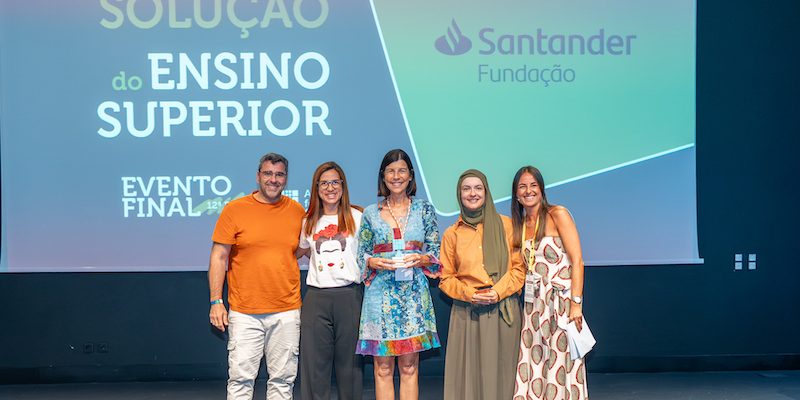
The Escola Egas Moniz – School of Health & Science was the big winner in the Higher Education Projects category of the 12th edition of Apps for Good. The school stood out with the GrowRight project, an app focused on children’s orofacial development. The solution aims to help parents and guardians identify warning signs related to the development of the dental arches and bite, offering simple exercises that support healthier habits and better muscle balance.
Aimed at families with growing children, the app addresses factors such as inappropriate oral habits, mouth breathing, thumb sucking and prolonged pacifier use. The project stresses that the app does not replace assessment or guidance from healthcare professionals.
At Egas Moniz, the programme was integrated into the Integrated Master’s in Dentistry, in the course unit Information and Communication Methodologies. The initiative involved more than 200 students, who were challenged to develop digital solutions to address challenges associated with SDG 3 (Good Health and Well-being), particularly in the area of oral health. The Local Meeting took place last June, as a moment for presenting and sharing the projects developed.
Egas Moniz’s participation is part of the debut of Apps for Good in Higher Education in Portugal, in an edition that marks a new stage for the programme run by CDI Portugal. For the first time in the international Apps for Good network, the programme was extended to Higher Education, positioning Portugal as the first country to bring this methodology to universities and polytechnic institutions.
The higher education strand, held for the first time this year, involved 9 educational institutions, 500 students and 20 teachers, with 93% of the projects developed in the field of education. This strong uptake confirms CDI Portugal’s innovative commitment to extending the project to Higher Education, in a pioneering initiative within the international Apps for Good network.
Over its 12 years of existence, Apps for Good has involved more than 35,000 students, 1,800 teachers and 800 schools, who have created thousands of technological solutions. The programme’s impact goes beyond the technical dimension, contributing to the development of skills such as creativity, critical thinking, leadership, collaboration and communication, as well as a greater desire among participants to contribute to a better world.

